

HealthStreet Cognitive Screening Project
- Need: Because early identification can impact the health and well-being outcomes of those with memory conditions, Florida's rural populations would benefit from access to screening followed by specialty referral for Alzheimer's Disease and other dementia types.
- Intervention: A state university used a state health department grant to develop a cognitive impairment screening program in rural Florida areas that was administered by Community Health Workers. An additional grant provided rural primary care clinicians with a free online continuing education module covering cognitive impairment and dementia.
- Results: At project completion, Community Health Workers had engaged nearly 600 participants to participate in health screenings and cognitive assessments, making about 1,300 referrals to community social and medical services.
Description
 Alzheimer's Disease (AD) is one of several
neurodegenerative conditions that impact an individual's
memory. According to an Alzheimer's
Association report, in 2020, AD was impacting over
half-a-million Floridians, a number second highest in the
nation with California having the most. In view of these
numbers, experts report several benefits linked to early
identification of AD and other dementia types: personal
and family emotional support needs, social, medical
intervention and treatment benefits, costs savings, and
increased time to plan for the conditions' future
impacts.
Alzheimer's Disease (AD) is one of several
neurodegenerative conditions that impact an individual's
memory. According to an Alzheimer's
Association report, in 2020, AD was impacting over
half-a-million Floridians, a number second highest in the
nation with California having the most. In view of these
numbers, experts report several benefits linked to early
identification of AD and other dementia types: personal
and family emotional support needs, social, medical
intervention and treatment benefits, costs savings, and
increased time to plan for the conditions' future
impacts.
With a 2017 grant from the Florida Department of Health's Ed and Ethel Moore Alzheimer's Disease Research Grant, the Department of Epidemiology at the University of Florida (UF) designed a research project that focused on collecting information from the state's rural population age 60 and older — a group proven by research to have not only a higher prevalence and death rate due to AD, but a group also less likely to be diagnosed, receive treatment, and be included in medical research. Although one urban county was included, outreach was specific to eight rural Florida counties chosen on the basis of their high AD mortality rates, four counties rural by CMS definition (Marion, Bay, Gulf, and Wakulla) and four designated as rural by the Federal Office of Rural Health Policy's definition (Putnam, Washington, Calhoun, and Jackson).

The grant leveraged UF's translational science infrastructure for community engagement. Grant goals included data collection, providing participants with local referral information when mortality-related health issues were identified and, for rural Florida healthcare providers, creating free easily-accessed educational offerings on the topic of cognitive impairment and dementia.
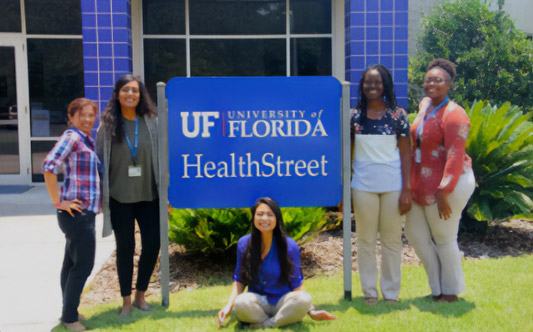
Participant data collection was done by the department's community engagement program called HealthStreet. Six certified HealthStreet Community Health Workers (CHWs) provided outreach at events like health fairs or in locations like community centers, public libraries, clinic settings, churches — even laundromats and bus stops in larger areas.
After obtaining informed consent, the CHWs collected sociodemographic information, reviewed medical and substance use history, and also assessed willingness to participate in future research efforts. Grant-specific data intake forms were used for the generalized health-related questions, an AD questionnaire, and the Montreal Cognitive Assessment (MoCA), a one-page screening tool with high sensitivity addressing items specific to memory.
Although MoCA results were not shared with participants, when assessments indicated the need, CHWs provided general education to the participant and their caregiver or family if present. Paper copies of information were provided at the time of the interaction.
CHW-participant conversations also included information on local social and medical services, including information for those participants without a medical home. At 2-months and 4-months after the original interaction, CHWs made follow-up calls to participants in order to address any interval questions and to follow-up on continued willingness to participate in future research. Contact information of community participants with continued interest in research activities was forwarded to research navigators who then connected with the appropriate university coordinator to further evaluate research study eligibility.
 Regarding the second
grant to engage the target county primary care
clinicians, email listservs and providers' professional
organizations were used to invite these clinicians to
participate in a free, online, continuing medical
education (CME) module,
From Brain Disorders to Brain Health: Prevention and
Management of Cognitive Decline and Dementia. The
module included overall review of cognitive conditions,
current screening and diagnostic tools, treatments, and
available resources for the practitioners themselves and
their patients — including specific information on
referring patients to the Florida's
designated memory clinics. Data collection for this
grant included pre- and post-activity surveys and
geographic location of provider participant.
Regarding the second
grant to engage the target county primary care
clinicians, email listservs and providers' professional
organizations were used to invite these clinicians to
participate in a free, online, continuing medical
education (CME) module,
From Brain Disorders to Brain Health: Prevention and
Management of Cognitive Decline and Dementia. The
module included overall review of cognitive conditions,
current screening and diagnostic tools, treatments, and
available resources for the practitioners themselves and
their patients — including specific information on
referring patients to the Florida's
designated memory clinics. Data collection for this
grant included pre- and post-activity surveys and
geographic location of provider participant.
Services offered
In addition to the continuing medical education information for clinical providers, key to the grant work were the HealthStreet CHWs, the grant-specific information forms, including cognitive screening tools. Also helpful were the community-specific resource guides created by the research team for each target county.
Results
As of December 2020, the CHW model of engagement with older adults had resulted in the enrollment nearly 600 older adults along with about 1,300 referrals to local community resources.
Challenges
- Recruitment of qualified applicants to serve as CHWs in rural Florida.
- Navigation of the circuitous pathway from CHW assessment to the eventual required physician-only referral to Florida's dementia care infrastructure
- For those participants with the referrals, transportation and other similar challenges to making an urban-located appointment
Replication
- Identification of geographic areas in most need of health assessments and cognitive screening
- Identification of collaborators with expertise in cognitive health to develop and create an educational intervention for clinicians
- Recruitment process and training protocol for CHWs
- Creation of forms for informed consent, health screening, and cognitive screening
- Identification and training of staff to create reports and complete data analyses
Contact Information
Linda B. Cottler, PhD, MPH, FACE, Associate Dean for Research and Dean's Professor, Department of Epidemiology and Director, HealthStreetUniversity of Florida, Gainesville, FL
352.294.5947
lbcottler@ufl.edu
Topics
Community health workers
· Dementia
· Health disparities
· Health screening
· Human services
· Needs assessment methods and resources
· Older adults
States served
Florida
Date updated or reviewed
March 23, 2026
Suggested citation: Rural Health Information Hub, 2026. HealthStreet Cognitive Screening Project [online]. Rural Health Information Hub. Available at: https://www.ruralhealthinfo.org/project-examples/1082 [Accessed 28 September 2026]
Please contact the models and innovations contact directly for the most complete and current information about this program. Summaries of models and innovations are provided by RHIhub for your convenience. The programs described are not endorsed by RHIhub or by the Federal Office of Rural Health Policy. Each rural community should consider whether a particular project or approach is a good match for their community’s needs and capacity. While it is sometimes possible to adapt program components to match your resources, keep in mind that changes to the program design may impact results.