January 29, 2020
Recent research has found that not only are nearly 40% of surveyed physicians burned out, but 40% are also experiencing depression. For many reasons — stigma among them — these professionals are not getting mental health support. Physician health programs, in collaboration with professional societies, are trying to change that by working with state licensure boards and other groups.
January 22, 2020
National research has revealed it and rural research suggests it: over 40% of today's physicians are burned out. This in-depth story reviews information about burnout in healthcare professions and for physicians in particular. Along with reviewing causes and impact, a medical school wellness-advocate, a researcher, and a large healthcare organization with a rural footprint shared interventions and solutions.
January 22, 2020
Over 40% of today's physicians are burned out. A closer look at research indicates that not only is this a system problem rather than an individual problem, but that burnout impacts a system's revenue streams, healthcare quality, and patient safety and satisfaction. Experts suggest the problem may even be of more concern in rural areas.
January 8, 2020
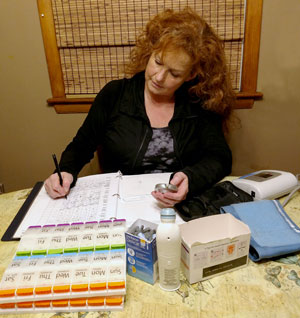
As people are living longer and trying to find solutions to delay the expense of long-term care or nursing facilities, family members, including adult children, are increasingly becoming informal, unpaid caregivers. Learn how technology may be a solution to help rural caregivers, what some of the challenges and opportunities are, and read about a current model that has the potential to change the landscape.
December 18, 2019
With national standards now available for voluntary accreditation, rural public health departments need to determine the feasibility of that activity for their organization. The Public Health Accreditation Board President and CEO joins researchers and experts to share information about accreditation and how rural health departments can achieve that designation.
December 18, 2019
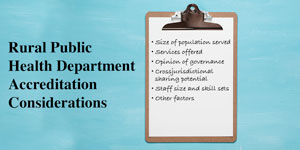
Governance, organizational size, and other factors may impact rural local health departments' ability to take on voluntary accreditation. In addition to a brief review of these issues, accreditation officials, professional societies, and researchers share how they are working together to better understand these challenges in order to support public health departments desiring accreditation.
December 18, 2019
Sharing how national and state voluntary accreditation helps their department meet the public health needs of their county's population — and its 8 million yearly visitors — Missouri's Taney County Health Department director Leslie Marshall also provides tips and ideas for other rural health departments thinking about accreditation.
December 4, 2019
Community Development Financial Institutions (CDFIs) can offer flexible financing options, but many operate at full capacity and there is a general lack of awareness of these institutions in rural spaces. Foundation and CDFI leaders share their perspectives about the difference CDFIs can make on rural health outcomes.
November 20, 2019
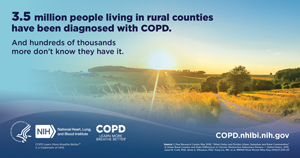
The National Heart, Lung, and Blood Institute calculates that 3.5 million rural Americans have COPD, or chronic obstructive pulmonary disease. It's also estimated that hundreds of thousands of rural Americans have the condition and don't know it. Though it is a condition without a cure, it is a condition with hope. The COPD Foundation's Chief Science Officer and a State Captain share how asking questions and doing spirometry can help diagnose the condition.
November 20, 2019
Chronic obstructive lung disease, or COPD, is a disease with a stronghold in rural America: almost double the prevalence and double the mortality rates compared to large urban areas. Though it is a condition with no cure, it's a condition that has treatments — and hope — making proper diagnosis by spirometry imperative.